






| ©Copyright 2002-2008 [Shawn Nacol] All rights reserved |


Of Human Brundage nostalgia by Ray Russell from Playboy Feb 1991 (vol 38, no. 2) pp. 106-109
a heartfelt valentine to illustrator Margaret Brundage, whose sumptuous writhing cover girl quickened many a young man's pulse
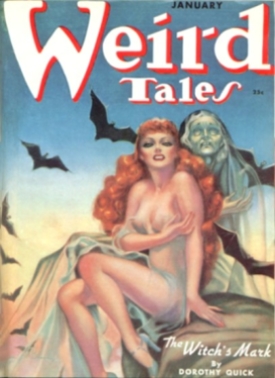
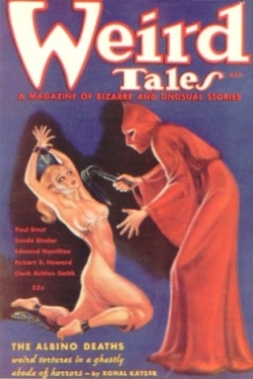
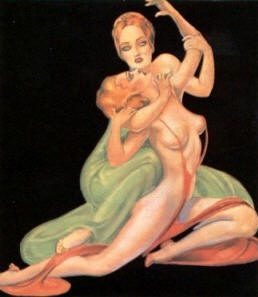
Today, of course, and for a fistful of decades, there has been the Playboy Playmate. Before her, in my childhood and adolescence, there was Esquire's Varga Girl, preceded by the Petty Girl, from the suave airbrushes of Alberto Vargas and George Petty, respectively. The Petty Girl, who seemed enormously daring to me whenever I was able to sneak a barbershop peek at her when I was a boy, now looks like tame stuff, indeed. But she had a full-bodied, pink-skinned contemporary, invariably nude, who sizzled on the covers of Weird Tales and who looks far from tame, even today. Striding glossily naked from head to foot, with a pack of faithful wolves as her companions, standing birth-bare and terrified among deadly cobras, lying stripped on a marble slab under the sacrificial knife of a half-naked priestess, standing nude before pagan idols and hostile hooded figures, she was that epitome of menaced maiden, the Brundage Girl. Margaret Brundage began working for Weird Tales with the September 1932 issue. She was not the first or the last of its cover artists to feature the undraped female form, but the crude nudes of the early C. Parker Petrie and C. C. Serif, or the painstakingly representational, anatomically accurate figures of Virgil Finlay, pale beside hers, and only the strange, imaginative---if almost abstract--art-deco work of Hugh Rankin offers any worthy competition to the Brundage Girl. Vivid, stylized, idiosyncratic, the naked lady of Margaret Brundage doubled as victim and villainess, by turns cowering or glowering, either cringing under or brandishing a whip that was by no means always figurative. This cover girl's flesh tones were sensuous and mouth-watering, her eyes large and imploring (if a victim), narrow and leering (if a vixen). Her legs were long and tapering, the thighs generously full. Her hands and feet were delicately modeled and always balletically poised. Her buttocks were rounded and womanly, her belly gently convex, her breasts perfectly formed and not too large. On some occasions, her nipples were unveiled, and when they were, they were revealed to be the delicate color of strawberry Necco wafers, a popular pastel candy of my youth. It was probably the waxing and waning of censorship and acceptability, and what the editors thought they could get away with, that determined whether or not those tempting confections could be seen. When they were covered, they were barely covered--by a wisp of hair, a shred of chiffon, a tendril of smoke, the strategic placement of which seemed to be Brundage's little nose-thumbing joke at the bluenoses. Unlike, say, Finlay's placid figures, which often seemed to be just planted there, immobile as potted plants, the Brundage Girl was always caught at a moment of ultimate drama and trauma, extreme stress and distress, intolerable persecution, raging displeasure; with wet lips parted, eyes rolling, flashing; her splendid body recoiling or looming with magniloquently theatrical outflinging of limbs. To this already-pungent sauce was added, more often than not, the patented Brundage sado-maso-lesbian spice that was essential to the psychodynamics of her unique aesthetic. It made her work steam and bubble and erupt from the cover, and still does, even half a century after publication.
Was Brundage a shrewd professional who exploited her readers' obsessions, fixations and fetishes, cynically tailoring her work to fit their tastes? Or did she share those tastes, and was it precisely that facet of her personality that energized and vitalized her art? If I seem to be persecuting Finlay, let me add that he was a legitimate illustrator of great skill who did honorable work that was an asset to the pulpwood magazines of the day. Brundage, on the other hand, was a trash artist. But she was a top trash artist of her time, and she may have been a kind of genius. Her work had zip, zest, pizzazz; it had luster and lust; it zoomed straight past the intellect and homed in on the viscera. Critics of Charles Dickens have said that his stagy, exaggerated characters aren't lifelike. More perceptive critics have said in rebuttal, Maybe not, but they're something much more important: They're alive. The same may be said of the Brundage Girl. | ||||

|
 The Brundage-Baywatch Connection
  |
